
Data 360: the data foundation every AI agent needs
Why AI agents are only as good as their data
In short: An AI agent can only act on the context it gets. Data 360, the Salesforce data engine formerly known as Data Cloud, connects customer data from your systems, unifies it, keeps it governed and gives each agent the part it needs at the moment it needs it. When agents give vague or wrong answers, check the data underneath before you blame the model.
Why AI agents need a data foundation
Ask an agent to prepare a sales call, answer a service request or build a campaign audience, and it needs the same things a good colleague would: who the customer is, what they bought, what they asked last week, which contracts are open and what they have agreed to receive. In most companies those answers sit in the CRM, the ERP, the web shop, the support tool and a few spreadsheets.
A person can work around the gaps. An agent will build a confident answer from whatever it can reach. That is why data readiness decides how far AI projects get. Gartner predicts that through 2026, organisations will abandon 60% of AI projects that are not supported by AI-ready data. In the same research, 63% of organisations said they either do not have the right data management practices for AI or are unsure whether they do.
We made the same point for marketing in Agentic Marketing: From Automation to Autonomy: an agent can only personalise what it can see.
What is Data 360?
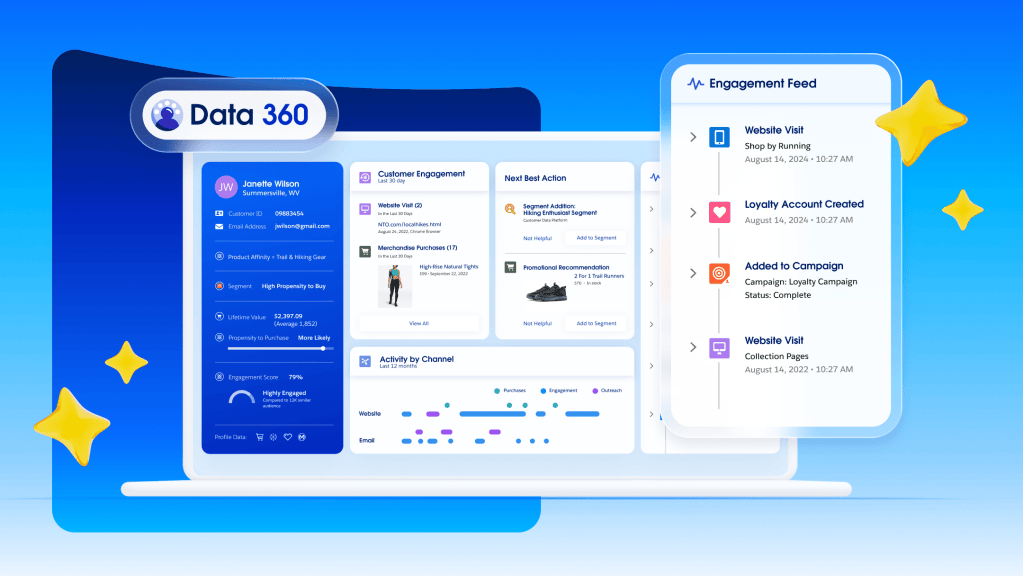
Salesforce describes Data 360 as the real-time data engine that powers the entire Salesforce platform. In practice it does four jobs:
- Connect. More than 200 prebuilt connectors bring in data from Salesforce clouds, MuleSoft, databases and other apps. With Zero Copy, Data 360 can also use data that stays in Snowflake, Databricks, Google Cloud or AWS without copying it.
- Unify. Data is mapped to one model, and identity resolution matches records from different systems into one unified profile per customer.
- Understand. Besides structured records, Data 360 works with unstructured content such as PDFs, call logs and wikis, and turns raw data into calculated insights and segments.
- Act and govern. Insights and segments flow into Sales, Service and Marketing Cloud, into Flow automation and into Agentforce, with tagging, classification, policy-based access and data masking applied along the way.
What’s new in Data 360 for agents
Salesforce now sums up Data 360 as a way to “give every human and AI agent trusted enterprise context”. Three recent announcements show what that means in practice.
Agent Context Engine
The Agent Context Engine is a shared context layer built on Data 360. For each request it assembles only the data an agent needs and is allowed to use. It follows permitted connections in a knowledge graph, uses a semantic layer based on Tableau Semantic Data Models so that business terms mean the same thing everywhere, and keeps a memory of approved facts together with where each fact came from. Existing Salesforce permissions, down to field level and sharing rules, apply while the context is assembled. It works with Agentforce and with agents built on other frameworks, such as Google ADK or LangGraph, and is currently in preview.
Data 360 Headless and MCP
Data 360 Headless makes the same context available outside Salesforce. Through the Data 360 MCP server, which uses the open Model Context Protocol, tools such as Claude, ChatGPT and Copilot can work with your customer data within Salesforce permissions. Authorised agents can do more than read records: they can map fields, inspect identity relationships, create segments and activate campaigns. Salesforce includes MCP access in Enterprise Edition and above, and it runs on your existing API limits.
Agentforce Coworker
Coworker, the AI assistant inside the Salesforce interface, is built on Data 360 and connects business information and actions across Salesforce, Gmail and other applications. Salesforce says 100,000 users activated it within its first 35 days. We will look at Coworker in more detail next Monday.
Whichever agent or interface asks the question, it should get the same trusted customer context under the same permissions.
What an agent-ready data foundation looks like
Before the first agent goes live, get the basics right for the data it will touch. Connecting every system can wait.
- One customer, one profile. Duplicates are merged or linked across systems.
- Consent travels with the profile. Agents need to know what each customer has agreed to, in every channel.
- Shared definitions. “Active customer”, “churn risk” and “open pipeline” mean the same thing in a report, a segment and an agent prompt.
- Fresh data where timing matters. A service agent working from yesterday’s order status will give the wrong answer today.
- Permissions that match reality. Agents act within the access rules you already have, so those rules have to be right.
It pays off in everyday sales work too. When sales, marketing and service see the same customer data, nobody has to guess which record is right, and customers don’t have to repeat themselves to every team. For more on why a single source of truth matters, read Humans and Agents: Unlocking Data.
Five steps to get your data ready for agents
1. Start with one agent and one job
Pick a use case with a clear owner and a measurable result, such as call preparation, case summaries or a reactivation campaign. Then list the data the agent needs for it.
2. Map your sources
For each data point, note where it lives, who owns it and how fresh it is. Decide what to bring into Data 360 and what to reach through Zero Copy in your data warehouse.
3. Fix identity first
Clean up duplicates in the CRM, agree on match rules and test identity resolution on real records before building on unified profiles.
4. Agree on definitions and consent
Write down the business terms your agents will use and connect consent and preference data to the profile, so segments and agent answers follow the same rules.
5. Govern and measure from day one
Review permission sets, sharing rules and data classification. Decide which actions need human approval, and track answer quality, time saved and data quality before and after the pilot.
How Cumultec can help
Cumultec is a Salesforce Consulting Partner working with companies across the Baltics, the Nordics and wider Europe. We help you assess your current data, design the Data 360 model, connect your sources and launch the first agent on top of it, with governance your IT and legal teams can sign off. Get in touch and let’s find out how ready your data is for agents.